Choosing a water heater is more than comparing prices in a showroom. It affects daily comfort, energy bills, installation space, and future maintenance. For every Water Heater House, the right system depends on household size, water usage, fuel availability, and local climate.
This guide examines ten common water heater types for house buyers. Options include traditional storage tanks, tankless units, heat pump models, solar systems, and compact point-of-use heaters. Each has practical strengths and limitations. A family of five may need faster recovery, while a small apartment may benefit from a smaller design. The cheapest model is not always the most economical choice.
Details matter. A basement tank may require floor drainage and enough clearance for servicing. A tankless heater may need upgraded electrical capacity or properly sized gas lines. Heat pump systems need suitable airflow and can produce a soft, steady operating sound. These points are easy to overlook.
Professional installation and manufacturer guidance should shape the final decision. Local building rules, water quality, warranty terms, and available technicians also deserve careful review. Product labels can help, but they do not replace an on-site assessment. That assumption can fail.
Some recommendations in this article may not fit every home. Energy savings vary with climate, usage habits, and maintenance. A trusted plumber or qualified energy adviser can confirm the details before purchase. Think beyond the purchase price. A reliable water heater should provide safe, consistent hot water while matching the home’s long-term needs.
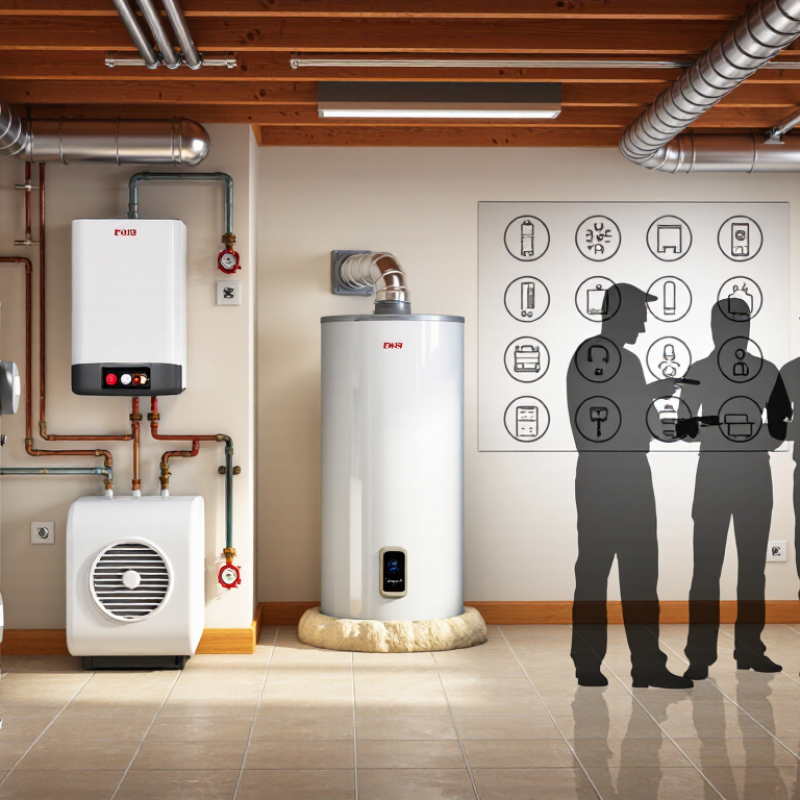
Water heaters transfer energy into cold water, then deliver it through insulated pipes. Storage-tank models keep heated water ready inside a large cylinder. That hidden tank matters. Electric elements warm the water quietly, while gas burners heat it faster but require proper ventilation. Tankless units heat water only when a tap opens. They save space, yet several showers may exceed their flow limit.
Heat-pump heaters move warmth from surrounding air into the tank. They usually use less electricity, but they need enough room and ventilation. Solar systems collect sunlight and often need backup heating during cloudy weather. Condensing gas models recover heat from exhaust, improving efficiency. Indirect heaters use a home’s boiler or furnace to warm stored water. Point-of-use units serve one sink, while standard electric and gas tanks remain familiar choices.
Buyers should compare fuel costs, recovery speed, first-hour capacity, noise, maintenance, and expected service life. Check the tank’s dimensions before assuming it will fit through a narrow doorway. Hard water can increase mineral buildup, especially around heating elements.
Ask for maintenance records and inspect the drain valve, pressure-relief valve, and visible corrosion. Local installation rules can affect venting, electrical capacity, and placement. A cheaper unit may cost more when upgrades are added.
Honestly, efficiency ratings do not show everything; household habits often matter more than the label. A small family may need less capacity, while back-to-back showers demand stronger recovery. Consult a qualified installer for final sizing.
For many house buyers, a conventional storage tank water heater offers familiar, predictable performance. It stores heated water in an insulated steel tank. When someone opens a tap, hot water is usually available within seconds. A 40- to 50-gallon tank often suits a small family, but household habits matter more than a simple bedroom count. Large soaking tubs and back-to-back showers can quickly expose a capacity mismatch.
Standby loss is real. Even when no tap is running, the tank reheats water throughout the day. A utility closet can feel warm. During a home inspection, check the tank’s age, pressure-relief valve, drain area, and visible corrosion. Rust around the base deserves serious attention. Ask whether the anode rod has been inspected, because it helps protect the tank from internal corrosion. Local plumbing requirements may also affect installation, venting, and earthquake restraints.
An experienced installer should verify water pressure and combustion ventilation where applicable. The temperature setting needs care, too. Excessive heat increases scalding risk, while a low setting may encourage poor hygiene conditions. Annual professional maintenance can include flushing sediment and testing safety controls. Still, maintenance records are often incomplete. That uncertainty should influence the buyer’s repair budget. Tank heaters are not automatically inefficient, but older insulation and heavy mineral buildup can raise energy use. In a hard-water area, a recently replaced unit may be more valuable than a larger, older tank.
For house buyers, the “top 10” water heater types include storage, tankless, heat pump, solar, condensing, indirect, point-of-use, electric, gas, and hybrid systems. Tankless heaters warm water only when needed. The U.S. Department of Energy reports that they can use 24–34% less energy in low-use homes and 8–14% less in high-use homes. Their compact design suits small utility rooms, but simultaneous showers may exceed flow capacity. Space matters.
Heat pump water heaters move heat instead of creating it directly. ENERGY STAR states that certified models use about 70% less energy than standard electric storage units and can save a typical household hundreds of dollars annually. They need clearance and a suitable ambient temperature. Cold garages can reduce performance, a detail often missed during showroom comparisons. Noise also deserves a night-time check.
Solar water heaters can supply roughly 50–80% of household hot-water demand, according to the U.S. Department of Energy. Roof direction, shading, local climate, and backup heating determine real savings. Solar needs backup. A professional site assessment should examine roof load, pipe length, water hardness, and household peak demand. Buyers should request measured efficiency, recovery rate, warranty terms, and installation records, not just optimistic payback estimates. My own caution is simple: the most efficient system can disappoint when its controls, storage size, or installation do not match daily habits.
Typical service life estimates in years, based on commonly reported residential equipment ranges. Actual longevity depends on water quality, maintenance, installation, and usage.
Tankless, solar thermal, and geothermal-assisted systems can last longer than conventional tank systems, while heat pump units generally offer higher efficiency with a comparable replacement cycle.
Water heating accounts for about 18% of U.S. household energy use, according to the U.S. Energy Information Administration. The right system matters. Condensing water heaters capture heat from exhaust gases, improving fuel use compared with conventional gas models. The U.S. Department of Energy reports that high-efficiency condensing units can exceed 90% thermal efficiency. They suit larger homes with steady demand, but require proper venting and condensate drainage. Installation mistakes can erase expected savings.
Point-of-use heaters serve one fixture, such as a kitchen sink or distant bathroom. They shorten the pipe run and reduce waiting time. DOE Building America research indicates distribution losses may represent 10% to 30% of water-heating energy. That makes point-of-use designs useful for additions, guest suites, and low-demand locations. Their output is limited, though. A small unit may disappoint during simultaneous use. Indirect water heaters use a boiler or furnace to heat stored water. They can work efficiently in homes with an existing hydronic heating system, but seasonal boiler use complicates the calculation. Sometimes, simpler is better.
Tips: Ask for the unit’s Uniform Energy Factor, recovery rate, and first-hour rating. Check the longest pipe run, not only household size. Get installation costs in writing. Energy savings estimates are never perfect; occupant habits, maintenance, and local fuel prices can change the result. Review annual service requirements before choosing a system.
| Water Heater Type | Primary Energy Source | Typical Efficiency or UEF | Storage and Output | Best Suited For | Main Advantages | Important Considerations | Typical Service Life |
|---|---|---|---|---|---|---|---|
| Conventional Gas Storage | Natural gas or propane | Typically about 0.55–0.70 UEF, depending on capacity and design | Usually 30–80 gallons; recovery is provided by a burner | Homes with gas service and moderate-to-high hot-water demand | Familiar technology, relatively fast recovery, and operation during power outages for some atmospheric models | Requires venting and combustion-air provisions; standby and flue losses reduce efficiency | Approximately 8–12 years with suitable maintenance |
| Standard Electric Storage | Electric resistance | Often about 0.90–0.95 UEF; nearly all supplied electricity becomes heat at the elements | Usually 30–80 gallons; heating speed depends on element wattage | Homes without gas service, apartments, and locations with simple electrical installation | Lower installation complexity, no combustion vent, and generally lower purchase cost | Can have higher operating costs where electricity is expensive; may require a dedicated 240-volt circuit | Approximately 10–15 years with an intact tank and regular maintenance |
| Non-Condensing Gas Tankless | Natural gas or propane | Commonly about 0.80–0.85 UEF | No storage tank; continuous flow is limited by unit input and temperature rise | Households seeking compact equipment and lower standby losses | Compact footprint, on-demand heating, and no tank-related standby heat loss | May need larger gas lines, special venting, electrical power, and periodic descaling; simultaneous fixtures can exceed flow capacity | Approximately 15–20 years when properly installed and serviced |
| Condensing Gas Tankless | Natural gas or propane | Often about 0.90–0.99 UEF | No storage tank; higher flow potential than many compact electric units | Larger households with high hot-water demand and available gas service | Uses a secondary heat exchanger to recover heat from exhaust vapor; high efficiency and reduced standby loss | Needs a condensate drain, suitable vent materials, gas capacity, electricity, and regular maintenance | Approximately 15–20 years with proper maintenance |
| Electric Tankless | Electric resistance | Typically about 0.93–0.99 UEF | No tank; output is limited by electrical capacity and incoming-water temperature | Small homes, additions, and locations where gas venting is impractical | Compact, quiet, and free of combustion emissions and flue requirements | High electrical demand may require multiple circuits or service upgrades; flow can be limited in cold climates | Approximately 15–20 years, depending on water quality and element replacement |
| Heat Pump Water Heater | Electricity used by a heat pump and backup resistance elements | Commonly about 2.0–4.0 UEF, depending on model and operating mode | Usually 40–80 gallons; recovery is slower in heat-pump-only mode | Efficient homes with a suitable utility room and moderate-to-high hot-water use | Can use substantially less electricity than resistance storage heaters and may dehumidify the surrounding air | Needs adequate air volume, condensate drainage, clearance, and tolerance for fan noise; performance varies with room temperature | Approximately 10–15 years, depending on maintenance and operating conditions |
| Solar Thermal Water Heater | Solar energy, usually with electric or gas backup | No single UEF is directly comparable; useful solar contribution depends on climate, collector area, orientation, and storage | Typically uses collectors, a storage tank, pumps, and a backup heater | Sunny locations with suitable roof space and long-term ownership plans | Can reduce purchased fuel or electricity for water heating and has low operating emissions | Higher installation complexity and upfront cost; requires backup heat during cloudy periods and may need freeze protection | Collectors often last 15–25 years; pumps and controls may require earlier replacement |
| Indirect Water Heater | Heat supplied by a boiler or hydronic heating system | Efficiency largely follows the boiler and system design; no independent burner rating applies to the storage tank | Usually 30–80 gallons; the boiler heats water through an internal heat exchanger | Homes that already use a hydronic boiler for space heating | Can provide strong recovery, fewer combustion components, and efficient year-round use with an appropriately sized boiler | Usually uneconomical without an existing boiler; space-heating and hot-water loads must be sized together | Tank life is often about 10–15 years; boiler life varies by equipment and maintenance |
| Point-of-Use Water Heater | Usually electric resistance; some specialized units use gas | Often about 0.90–0.99 UEF for electric models, depending on design | Typically 0.5–10 gallons for small storage units, or limited flow for compact tankless units | Remote sinks, guest bathrooms, additions, offices, and long pipe runs | Reduces waiting time and pipe heat loss while avoiding the need to extend a large hot-water distribution line | Limited capacity; multiple fixtures may need separate units, and installation must meet local electrical and plumbing requirements | Approximately 5–15 years, depending on whether the unit has a tank or tankless design |
| Condensing Gas Storage | Natural gas or propane | Often about 0.80–0.95 UEF, depending on tank size and operating conditions | Usually 30–75 gallons; stores hot water while recovering heat from exhaust vapor | Homes wanting gas storage capacity with higher efficiency than conventional atmospheric models | Combines stored hot water with heat recovery and generally has lower exhaust losses than standard gas storage | Requires condensate disposal, sealed or specialized venting, electrical power, and qualified installation | Approximately 8–15 years, depending on tank construction and maintenance |
Choosing a water heater starts with household habits, not appearance. Count how many people shower, wash dishes, or do laundry simultaneously. A small tank may serve two adults, but a larger family needs stronger recovery. Check the first-hour rating, which estimates available hot water during peak use. Do not guess. Measure the installation space, door clearance, and nearby electrical or gas connections. A narrow utility closet may eliminate several suitable models.
Conventional storage heaters offer simple operation and familiar maintenance. Tankless units save space, but they need adequate flow and electrical capacity. Heat pump systems can reduce energy use, although they need airflow and may produce mild operating noise. Solar systems can work well in sunny regions, but they usually require backup heating.
Point-of-use heaters suit distant sinks, not whole-house demand. Condensing models may improve efficiency when compatible with the fuel system. Indirect heaters depend on a boiler or another heat source. Electric and gas versions also differ in installation costs, ventilation, and ongoing expenses.
Energy labels help, but they do not tell the whole story. Compare annual energy estimates with local utility prices. Ask a licensed installer to verify pressure, venting, drainage, and safety controls. Local rules can change the practical choice. I would also inspect the old heater for rust, leaks, and mineral buildup before replacing it. That evidence may reveal poor sizing or water-quality problems. The cheapest purchase can become expensive when repairs, upgrades, or frequent cold showers follow.
It captures heat from exhaust gases before they leave the system. High-efficiency models can exceed 90% thermal efficiency. They need correct venting and condensate drainage. Installation errors can erase expected savings.
It serves one fixture, such as a distant bathroom sink. Shorter pipes reduce waiting time and distribution losses. It suits additions, guest rooms, and low-demand locations. Its output is limited.
Usually, no. A small unit may struggle during simultaneous showers and laundry. Check flow requirements carefully. A tiny heater can disappoint quickly.
It uses a boiler or furnace to heat stored water. This can work well with existing hydronic heating. Seasonal boiler operation complicates savings estimates. Sometimes, simpler equipment is better.
Count simultaneous showers, dishwashing, and laundry. Use the first-hour rating, not household size alone. A small tank may suit two adults. Larger families need stronger recovery.
Measure closet width, height, depth, and door clearance. Check nearby electrical, gas, water, and drainage connections. A narrow closet may eliminate suitable models. Measure the longest pipe run, too.
Ask for the Uniform Energy Factor, recovery rate, and first-hour rating. Compare annual energy estimates with local fuel prices. Labels help, but they do not show every cost. My estimate would still be imperfect.
Ask a licensed installer to verify pressure, venting, drainage, and safety controls. Get installation costs in writing. Local requirements may change the practical choice. Details matter.
No. Heat pump systems need airflow and may create mild operating noise. Solar systems usually need backup heating. Tankless units require adequate flow and electrical capacity. The best option depends on the home.
Choosing the right water heater requires understanding how each system heats, stores, and delivers hot water. Buyers should compare energy efficiency, capacity, recovery speed, installation requirements, operating costs, maintenance needs, and expected lifespan. Conventional storage tank models are familiar and reliable, while tankless systems heat water on demand and can save space. Heat pump water heaters use electricity more efficiently, and solar models can reduce dependence on conventional energy when site conditions are suitable.
Other options include condensing water heaters, which capture additional heat from exhaust, point-of-use units designed for individual fixtures, and indirect systems that work with a separate heating source. The best Water Heater House solution depends on household size, daily hot-water demand, climate, available space, budget, and local utility conditions. By balancing upfront price with long-term performance and practical installation considerations, homeowners can select a system that provides dependable hot water while supporting efficiency and comfort.

Huayida